LSE alumni Joss Harrison and Bala Nagendran Marimuthu as part of the LSE Change Makers project developed a practical framework that can be adapted to different teaching contexts. This framework can help you reflect on your own teaching materials if you are working alone. However, if you are part of a larger Course Team, it can help coordinate efforts across a shared module. At programme or departmental level, the same approach can help map how sustainability learning outcomes are developed and reinforced across multiple courses. As you can see here, this stepwise framework takes the form of an easy-to-use, five-layer template that can guide you through a sequential process of integration.
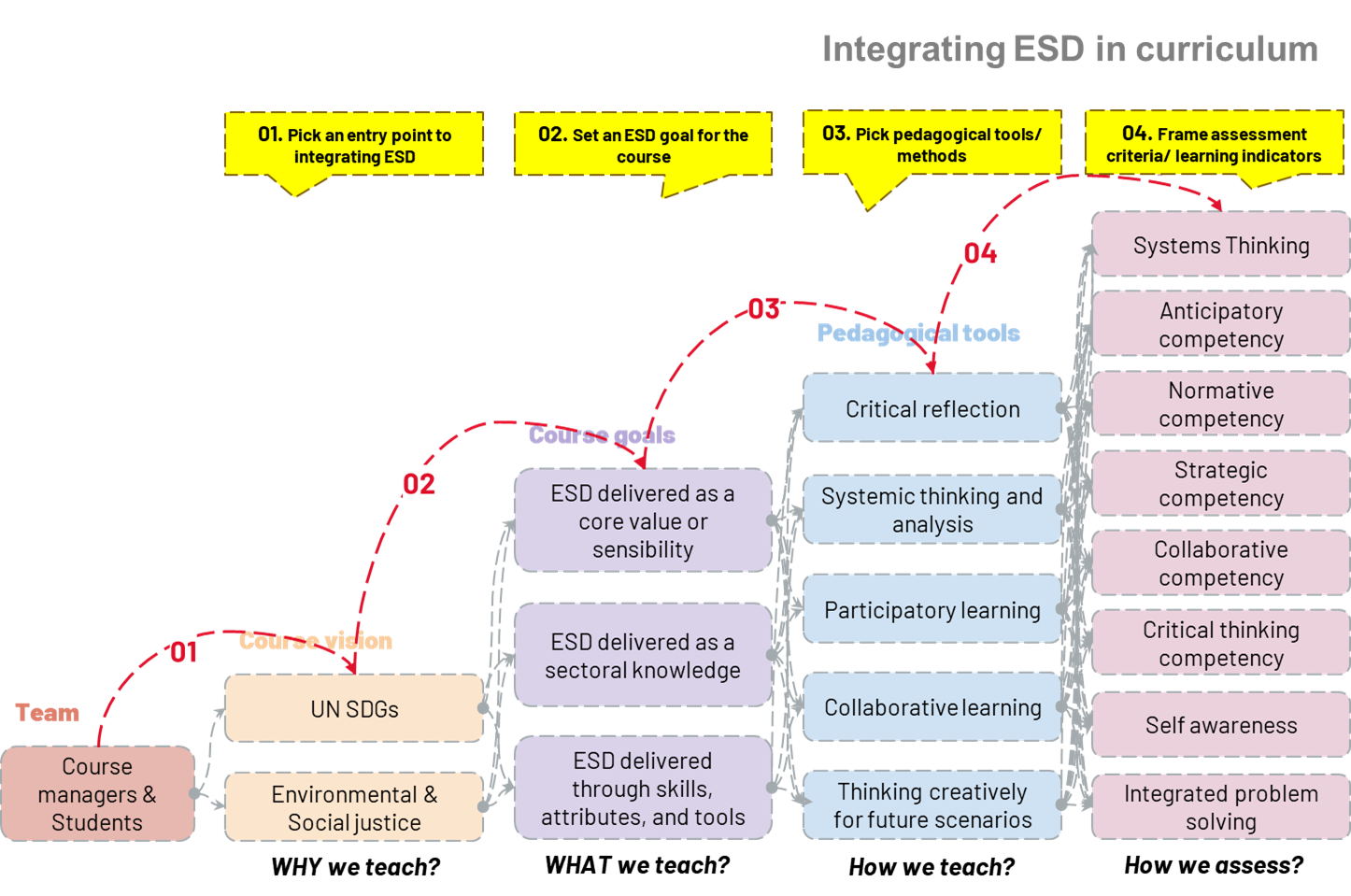
Each layer listed below helps clarify both the what, why and the how of embedding EfS principles into teaching practice:
- Course Team refers to a small working team headed by the course manager with student representatives and other teaching staff involved in delivering the course module.
- Course Vision (WHY do we teach this course module?) stands for an entry point or an academic perspective or lens to guide the ESD integration process (e.g. United National Sustainable Development Goals, Environmental and Social Justice etc.). The course team could also use other relevant entry point/s.
- Course Goals (WHAT do we teach through this course module?) recommends a critical reflection on the content of the course module in alignment with ESD. While every course module has the opportunity to embed ESD, the approach could vary to deliver it as a core value or sensibility; as a sectoral knowledge; and/or through skills, attributes, and tools.
- Course Pedagogy (HOW do we teach this course module?) lists a range of tools and methods to deliver the course, based on Eden Centre’s recommendation.
The students’ publication is available in full here on the LSE Eden Centre website.