The CIVICA multi-campus course The Future of Europe, coordinated by Carlo Altomonte, is an online extracurricular programme open to postgraduate students across the CIVICA university alliance.
It brings together students from across Europe to analyse key European policy challenges through four thematic modules: Globalisation, economic and security shocks; Democracy, governance and populism; Environment, sustainability and the EU Green Deal; and Digitalisation and innovation. Alongside live lectures, students collaborate on a capstone policy project tackling real-world EU issues. Since its inception, more than 520 students have benefited from this experience.
 Photos ©Bocconi University
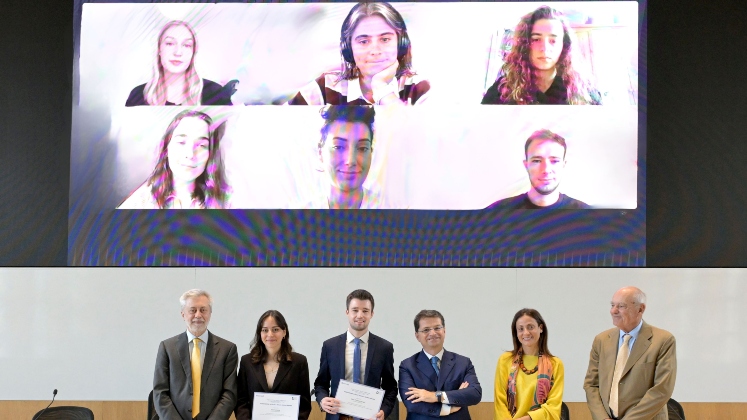
Read the following interview with Jemima and Lisa, two of LSE students whose team won an award on 4 May 2026. Jemima O’Reilly is studying a master's in International Relations, and Lisa Levytska is pursuing a master’s in Financial History.
Why did you choose to come to LSE and why were you motivated to apply to the CIVICA multi-campus course?
Jemima: I was drawn to LSE because of its strong reputation in the social sciences and its international cohort. My studies at LSE have provided me with a solid foundation in international relations, developing my knowledge of theories and practical strategies. The CIVICA course appealed to me because it offered a genuinely international and collaborative learning environment. The opportunity to work with students from different academic systems and cultural backgrounds felt like a unique way to broaden my perspective.
Lisa: For my master's degree, I wanted to come to LSE because no other university in the UK, and possibly in Europe, teaches Financial History. What differentiates my course is its focus on the roots of major economic developments, rather than their impact – we look at financial institutions, how they fit within financial markets, and how their moving parts can lead to financial crises or changes in the international economic order. That was exactly what I wanted to study. Another big benefit of studying any finance-related course at LSE is being in London – one of the global financial capitals – which really brings what you’re studying to life a lot of the time. That was a great appeal of LSE too. Also, since LSE is known for its international student body, I knew it would be a great fit for me.
I was motivated to apply to the CIVICA multi-campus course because some topics it covered aligned really well with my dissertation (for example, Module 1: Globalisation, Economic and Security Shocks), some have been topics of interest since my undergraduate degree (i.e., Module 3: Environment, Sustainability & the EU Green Deal), and some were very important topics to be knowledgeable on in this day and age, given the current political and technological developments (Module 2: Democracy, Governance, and Populism in The EU and Module 4: Digitalisation and Innovation in The New Europe). Also, I was intrigued by the capstone project as it involved writing a policy paper, which I had never done before and I thought would be a great new skill to learn. Finally, I really appreciated the international component of the course – it was great to come to LSE and experience teaching and meeting people from 9 other universities!
What did you work on in your capstone group project? What universities did your other team members come from?
Jemima: For our capstone project, we looked at political polarisation within European youth through social media platforms. We proposed a dual strategy to educate young people about digital literacy and how to navigate these forums in political contexts. My teammates came from a range of CIVICA universities such as Sciences Po and Hertie School.
Lisa: Our project was anchored in Module 3: Environment, Sustainability & the EU Green Deal, and we decided to analyse how corporate vehicles can drive Europe’s Clean Industrial Deal. In our paper, we proposed a targeted regulation requiring large fleet operators to gradually adopt zero-emission vehicles while exempting SMEs and synchronising tax incentives across Member States. We chose to focus on the corporate fleet as it dominates vehicle purchases and shapes the second-hand market, so a fair transition is crucial for achieving the 2030 climate targets.
We had a really good team – two of our team members studied at Bocconi University and had prior experience working in the sustainability space through internships and coursework, and we also had teammates from the Hertie School and LSE – all from different disciplines, which greatly contributed to how we approached and thought about the project.
How do you hope this experience will benefit you?
Jemima: I see this experience as strengthening both my academic and professional skill sets. It improved my ability to communicate complex ideas clearly and adapt to different approaches to problem-solving. It also deepened my interest in collaborative, cross-border work, which I hope to pursue in my future career.
Lisa: Getting involved in the course unexpectedly helped me find direction for my MSc dissertation. Before coming to LSE, I had already developed a research proposal, but it was missing the final ‘so what?’. Having taken part in the policy paper training camp as part of the CIVICA multi-campus course, I realised I wanted to include policy analysis and recommendations in the conclusion of my research. So, in a way, this experience has already benefited me.
On a slightly different note, completing the course made me realise that I am under-engaging with current affairs from a critical standpoint: the course showed me that simply reading the news without developing a more nuanced understanding from a wider range of sources isn’t enough. So, I decided to join Chatham House, which, to me, felt like a long-term way to keep up with the topics I found interesting in the course. In my application for the Chatham House membership, I wrote about my work on the capstone project, and since becoming a member, I feel I have built on the foundation the course gave me.
What is your main take away from participating in the CIVICA Multi-campus course?
Jemima: My main takeaway is that interdisciplinary and international collaboration is not only important but vital to the future of Europe. If Europe wants to re-invent itself as a competitive force in this increasingly multipolar world order, it must forge connections from within. Approaching challenges from new perspectives is what sets Europe apart.
Lisa: My main takeaway from participating in the CIVICA multi-campus course is that there’s so much more to learn and so many ways to do so. I think this course was an important experience for me, especially at this point in my academic life, because it helped me develop new or more elaborate perspectives and taught me new practical skills that will be key to my current work.
Do you have any advice for people who are thinking about applying but aren’t sure?
Jemima: I would strongly encourage you to apply. It’s an intensive experience, but that’s what makes it worthwhile. Even if it feels challenging at first, the rewards you gain are significant in all aspects of your life, whether professional or personal.
Lisa: Give it a go! Regardless of what you’re studying, the course’s focus on current affairs makes it relevant, and the wide range of topics covered means that there’s something for everyone. The time commitment is manageable, and there is a good scope for adjustment, given that the lectures are recorded and the readings are available in advance, so it really comes down to what you make of it.
Why should future students take part in this opportunity?
Jemima: It gives you the opportunity to engage with current social challenges from an international perspective. The capstone project gives you the opportunity to put your previous academic skills to work in preparing a ‘real’ policy paper (a skill that’s really useful when it comes to applying for public sector jobs).
Lisa: In addition to everything already mentioned, I must highlight the international component of the experience. LSE students should take part in this opportunity because, coming from a university with a diverse international community, it will further strengthen their approach to intercultural exchanges and likely complement the way they collaborate with their peers at LSE. The CIVICA multi-campus course is a great way to meet students from abroad and learn from them, while developing soft skills and working in an environment that is likely to resemble their future workplace, characterised by working within time constraints, internationally, across time zones, and online.
What are you excited about going forward?
Jemima: I’m looking forward to building on the connections and skills I've developed through this experience. I’m also excited to be finishing up my dissertation and to start my new job in September at Orbit Partners as an Associate.
Lisa: Right now, my exams and dissertation are in focus. I am excited to draw on the knowledge I gained from the CIVICA multi-campus course and translate it into my work at LSE. Beyond academics, I’m looking forward to my summer internship this June and seeing where this year takes me next.
Interested in European policy, international collaboration and real-world impact?
Explore how CIVICA activities can expand your academic and professional horizons here.