Carolin Hulke is an economic geographer, who joined the Department of Geography and Environment in 2023 as Assistant Professor. She teaches local and regional economic development, and works on evolutionary economic geography, global and regional value chains, and sustainability in the global South.
In this interview, she tells us about her research and her most recent project↓
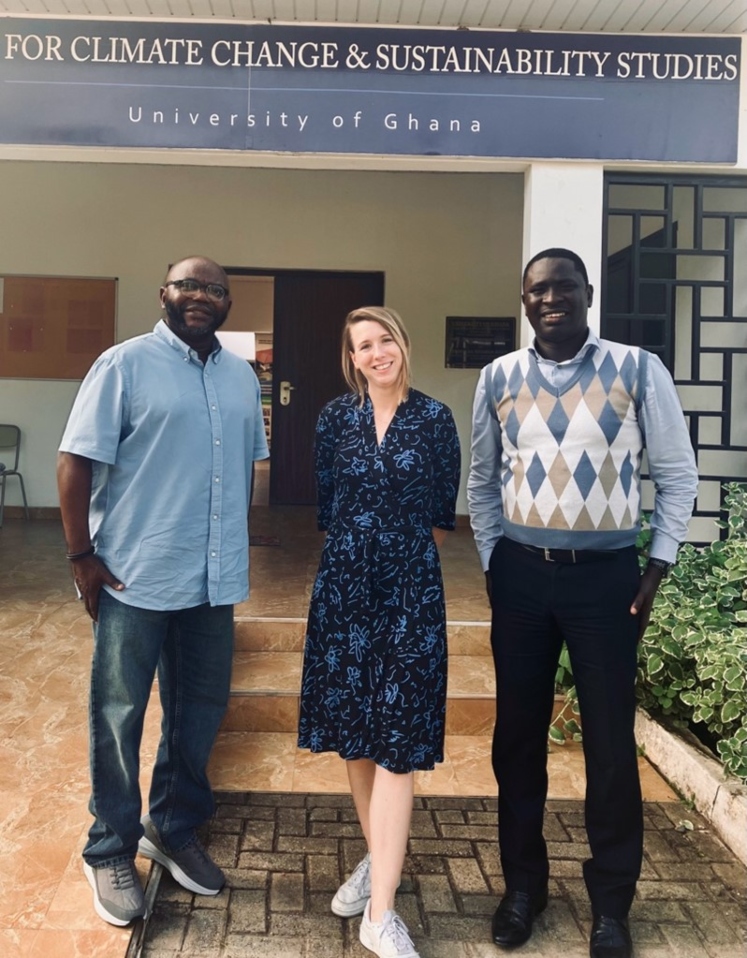 Photos ©C. Hulke, from left to right: Robert Manteaw, Carolin Hulke, Michael Tuffour
Could you tell us about your research?
My research links economic geography, development studies, and environmental governance. I am particularly interested in how global economic processes and their governance shape local development outcomes in the global South. This could be in the form of global or regional value chains, investment flows, and international and domestic regulation.
A core theme running through my work is power, governance and institutions: who sets the rules, who benefits, and who bears the risks when economies undergo processes of transformation, especially from the micro perspective, such as smallholder farmers, local communities, small enterprises and civil society actors.
What attracted you to this particular area of research?
I have long been interested in how ‘sustainability initiatives’ unfold in practice, especially in contexts marked by inequality and uneven development. Carbon markets are often presented as a “win–win” solution, reducing carbon emissions, channelling private investment, and helping affected communities to adapt to changing climates. But my earlier work on horticulture value chains and tourism development has shown that such transitions are rarely neutral. They tend to create new winners and losers, often in ways that are not immediately visible.
We are currently witnessing the early stages of a new global regulatory regime in market-based mechanisms for climate change mitigation and adaptation. With Article 6 of the Paris Agreement being operational for a couple of years now, carbon markets are being reshaped under international rules that explicitly promise sustainable development outcomes especially in global South countries. This creates a rare opportunity to study how these rules are negotiated, implemented, and contested before they become fully institutionalised.
Ghana’s role as a frontrunner, particularly in agriculture, makes it an ideal setting to explore whether these promises can be realised in practice, and to understand the potentials and pitfalls early on in the process. As many African countries are preparing to access Article 6 carbon trading in the next years, much can be learned from this country case, not only for the host countries of carbon reducing projects through trading with emission reduction credits, but also for buying countries in Europe or Asia.
How do you hope your research will contribute to better society and policy outcomes?
In my view, there is a considerable research gap in knowledge about carbon markets and their (uneven) economic geographies. While past carbon markets have been studied extensively, we know surprisingly little about their governance changes, local development effects, and how they impact domestic or global value chains in the global South. By combining national-level survey data with in-depth qualitative research, the project provides empirical evidence on how carbon trading reshapes livelihoods, land use, and power relations. From a policy perspective, the research aims to inform the design of more inclusive and sustainable carbon market mechanisms.
By engaging directly with policymakers, regulators, and practitioners in Ghana, the project generates insights that are relevant not only nationally but also internationally, as Article 6 is rolled out in other countries. Ultimately, the goal is to contribute to climate finance arrangements that support emissions reductions while also strengthening food security, farmer welfare, and local economic development.
How did your GRF related project come about?
With support from the Global Research Fund, I was able to solidify my research collaboration with partner universities. Together with Dr Michael Tuffour (Senior Lecturer and Head of the Department of Sustainable Development and Policy, University of Environment and Sustainable Development, Ghana) and Dr Robert Manteaw (Senior Research Fellow, Center for Climate Change and Sustainability Studies, University of Ghana) through a number of joint activities that built on a prior exploratory research trip.
The GRF funding allowed us to organise a researcher–stakeholder workshop on “Carbon markets for sustainable development in Ghana – current challenges and future potentials under Article 6 of the Paris Agreement,” in Accra in June 2025, followed by an internal workshop with the co-organisers to digest the findings and develop a research agenda.
The activity brought together more 25 representatives from Ghana’s carbon market landscape, including Environmental Protection Agency, private‑sector project developers, NGOs and academics as well as more than 30 students and civil society actors to exchange knowledge and provide a platform for an open dialogue. These early insights revealed both the potential and the risks of carbon market-based interventions, and they laid the foundation for a larger research agenda.
What initiated your collaboration?
The collaboration developed organically through shared research interests and complementary expertise and based on existing networks between the LSE and the University of Ghana. My Ghanaian colleagues are deeply embedded in the country’s agricultural and environmental policy landscape and have extensive experience working with farming communities and climate practitioners and policy makers. We began working together during a first exploratory fieldwork phase in 2024, conducting interviews and focus groups jointly and discussing findings throughout the process.
Since then, the collaboration has been sustained through regular meetings and joint planning for future research phases, ideally within a larger research grant based on an extensive research agenda in the field of carbon trading in Ghana. Beyond that, we are working on two publications based on the qualitative data we collected within the past two years and extensive document analysis.
What do you expect this collaboration will lead to?
In the short term, the collaboration will lead to joint academic and policy-oriented outputs that contribute to debates on carbon markets, agricultural development, and sustainability transitions. We are also producing and open access working paper and shorter policy briefs to ensure that findings are accessible to practitioners and policymakers.
In the longer term, I see this collaboration as the foundation for a sustained research programme on carbon markets and local economic development in Africa. More broadly, I hope the collaboration contributes to shaping more equitable and context-sensitive approaches to climate finance in the years to come.