Dr Louis Henderson based in the Department of Economic History investigates human capital accumulation during early industrialisation. His research examines how institutions such as the family and schools affect human capital supply and how technological change affects its demand.
Dr Henderson was awarded a grant from the Global Research Fund in 2025 to undertake archival work on eighteenth-century plea rolls meant to contribute to a project on technology adoption during the industrial revolution. He shares his experience of spending time with the primary source documents and training a machine learning tool↓
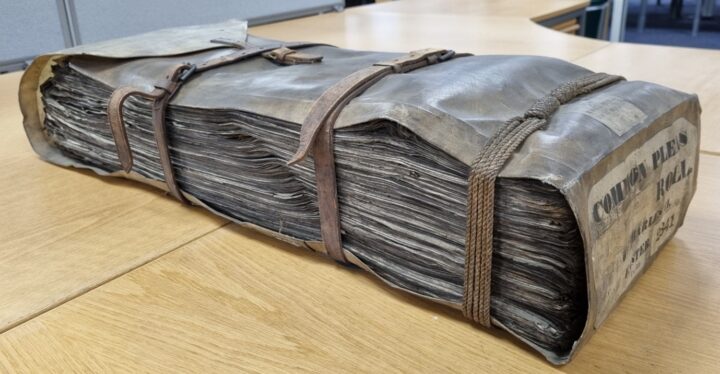 Plea Roll ©National Archives
Can you tell us a bit about your research? What do you work on?
I am interested in what one generation leaves to the next. Most of the time, I study how parent-child relationships have changed over time and how this affects social reproduction and human capital accumulation, but I am also interested in more public kinds of institutional legacies, particularly in collaborative projects such as this one.
Methodologically, I am attracted to archival research because if you know what to look for, you can often find data that lets you answer richer questions than would be possible with conventional administrative datasets. It’s also very satisfying to dig through an old box of documents that may be several hundred years old and to think of all the people who touched them before you!
What attracted you to this particular area of research?
Interests accrete over time, but I have always been interested in understanding how families transmit economic resources and social outcomes between generations. It is such a fundamental part of our narratives about ourselves and others. Once you start thinking about it, this interest connects to a very expansive set of phenomena. It relates to the effectiveness of policy. For example, are public investments in education complements or substitutes for private care? What does this imply for efforts to reduce inequality via education? This raises a whole range of ethical questions that political philosophers like Rawls have explored, for example, about opportunity and justice. It is hard to draw a line at where to stop being interested.
It is also natural to approach this historically. A generation is a long time, and the political, economic, and social institutions that exist across that span actively shape how families transmit resources and opportunities. Because these things change slowly, you have to take a long view to study them properly.
How did this particular project come about?
This project grew out of a conversation with Robert Merges and Moritz Kaiser about how the historiography on steam-engine adoption did not seem to properly account for the costs of conflict over riparian rights associated with the alternative motive technology, water wheels. Maybe steam engines were adopted by eighteenth-century textile manufacturers to avoid the costs of conflict.
We were also thinking about an argument made by Mokyr, Sarid, and van der Beek (2022), who say that places that had established water mills tended to go on to adopt steam engines because they had attracted local pools of engineering talent, the millwrights who installed and maintained both machines. Although the human capital story is interesting, we doubted whether mechanics were really so immobile in the eighteenth century. At the time, I had just been reading Elinor Ostrom, and I also had some personal experience of water rights disputes from working on a farm as an undergraduate.The idea that something similar may have been happening in eighteenth century Lancashire came to mind as an alternative explanation for spatial persistence. Where there were more water users drawing from the same streams, there would be more potential for conflict, and this might have raised the relative profit from steam engine adoption.
The potential historical irony was too striking to ignore. We needed to know whether capitalists adopted steam engines to avoid conflict over common-pool resources, and in burning coal contributed to a much larger conflict over common resources in the form of future anthropogenic climate change. We kept pulling on the thread, collecting relevant secondary material, and we were very glad to get the opportunity to collect this data on conflicts and pursue the research further.
What did you work on during your trips?
My colleagues and I surveyed the documents in the National Archives at Kew related to eighteenth-century common law courts. We identified a collection of plea rolls that would be most useful to our project, which contained rich information on the nature of cases brought to the court (although not necessarily to trial) and the plaintiffs. Once we had identified the most relevant material, we took a very large sample of photographs of the documents for later transcription using Transkribus, a new machine-learning tool for historical manuscripts. We also collected a very large amount of eighteenth-century dust under our fingernails (see photo).
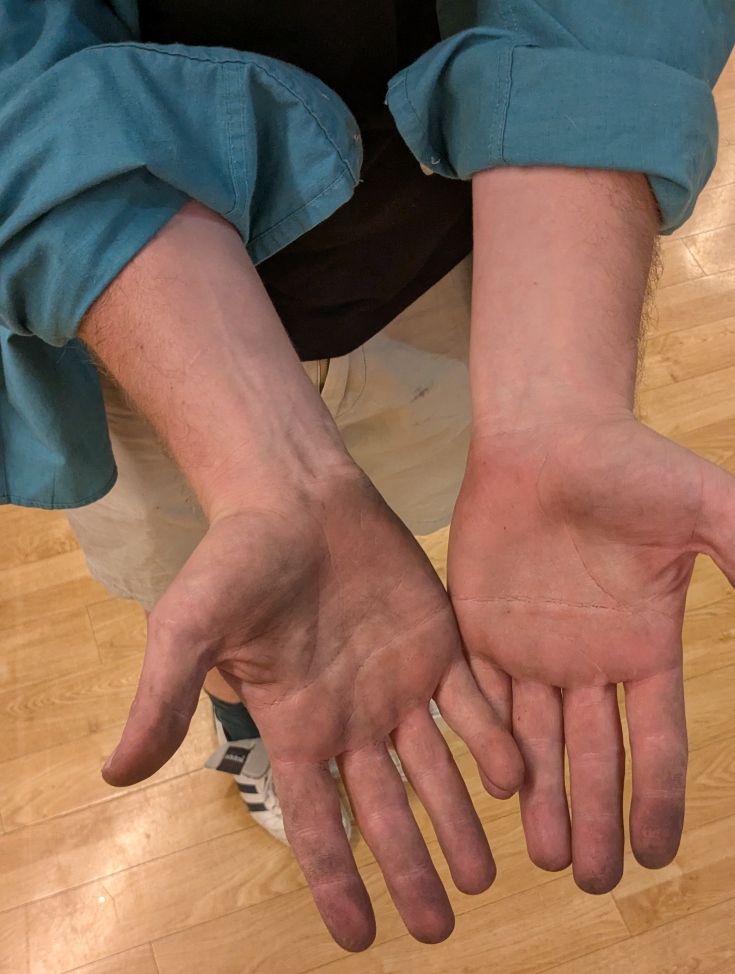 Photo ©Louis Henderson
How do you hope your research will contribute to a better understanding of the period?
Since Douglass North's work on how institutions shape economic outcomes, the idea that institutions matter has become something of a given in economic history. I hope this research adds some nuance to that story. For one, it may be an example of institutional failure actually encouraging technological adoption rather than impeding it. But the bigger historical lesson may be that technological responses to institutional failings can produce larger problems in the long run — a thought that is hard to consider without thinking about anthropogenic climate change.
What has this project led to?
This summer we are running a summer school in Tübingen titled Political Economy of Natural Resources and Environmental Change, where I will be giving a practical workshop on digitising handwritten records using the latest machine-learning tools, as well as introducing other participants to the dataset.
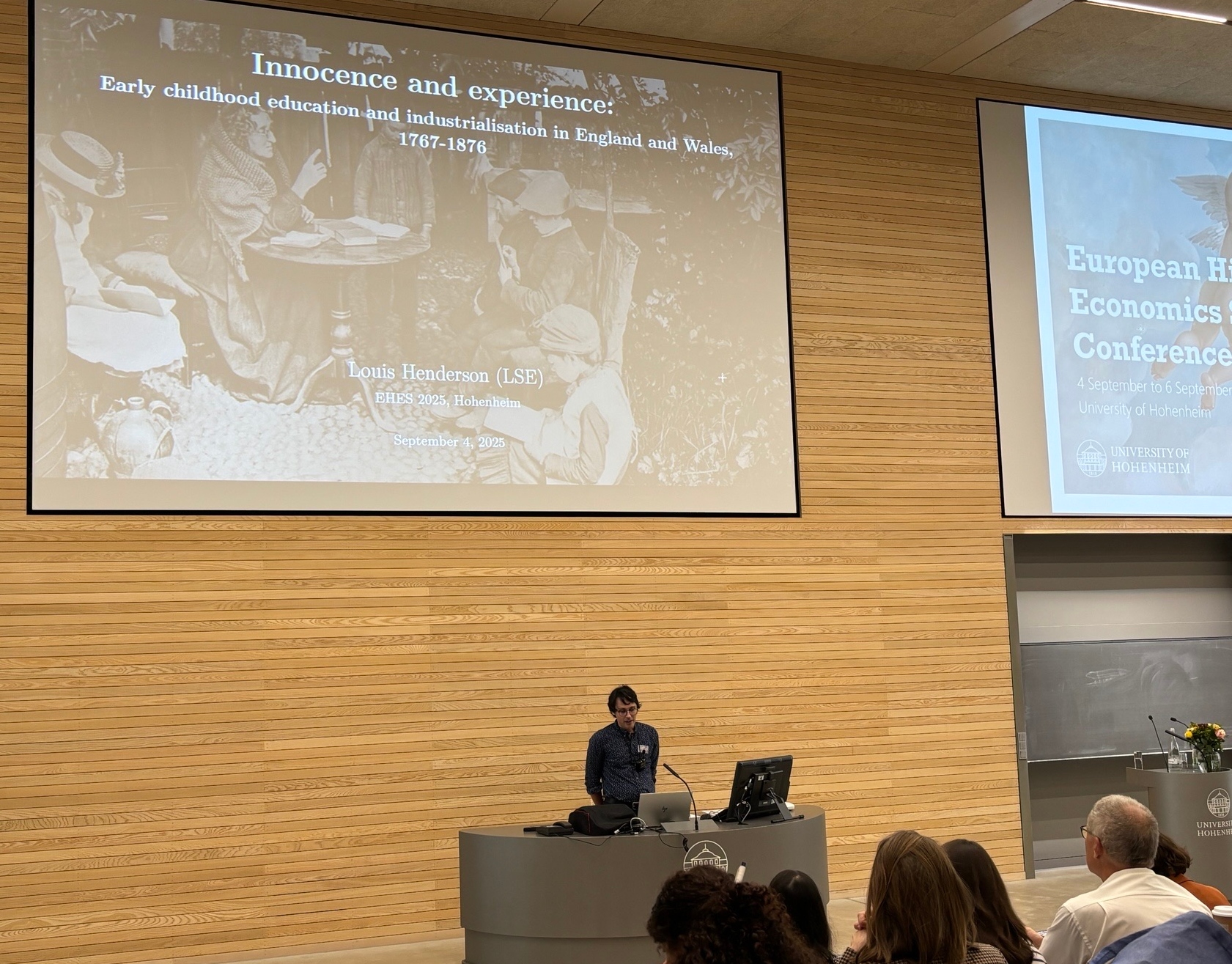 Photo ©Benjamin Schneider
Where do you see this work on plea rolls going?
The plea rolls have information on a much wider range of disputes than just water rights, including conflict over customary rights and land, so we expect there will be many “downstream” projects flowing from this work. We plan to make the dataset available to other economic historians once it is fully digitised, and we think there is a lot of work that can be done with it. If any of this sounds interesting, please do get in touch. We are always looking for collaborators.
If you are working on an international project and want to discuss how we can support you, please contact our Senior Global Research Partnerships & Alliances Manager and explore our funding opportunities pages.