Dr. Qingfei Yin works in the Department of International History. As a historian of contemporary China and inter-Asian relations, her research focuses on China’s relations with its Asian neighbours and the Cold War in Asia.
Qingfei benefited from the Global Research Fund to spend time on her latest project ‘Building Mao’s “Railway on the Sea”: A Global History of China’s Ocean Shipping during the Cold War’ and shares her experience of spending time in Shanghai, Shenzhen and Guangzhou. ↓
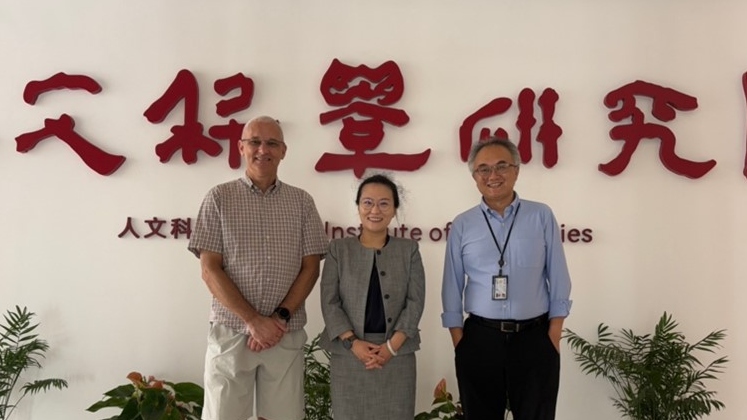 Workshop at the Institute of Humanities of ShanghaiTech University. Photos ©Qingfei Yin, from left to right: Mark Hoskin, Qingfei Yin, Xin Fan.
Could you tell us about your research?
After publishing my first book State Building in Cold War Asia: Comrades and Competitors on the Sino-Vietnamese Border (Cambridge University Press, 2024), I have been exploring new angles from which to examine how the global Cold War intersected with state-building projects in Asia.
I am currently working on two book projects. The first is a history of Chinese seamen during the Cold War. It examines how ethnic Chinese maritime laborers were simultaneously constrained by—and able to navigate—the geopolitical tensions across the Taiwan Strait, the broader East–West divide, and the profound transformation of the global shipping industry in the second half of the twentieth century.
The second project, tentatively titled ‘Building Mao’s “Railway on the Sea”,’ traces the development of China’s ocean shipping industry during the Mao era. This research seeks to reassess China’s economic connections with the outside world before its rise as a major global economic power, as well as Beijing’s evolving perceptions of the sea and maritime power in the context of the Cold War.
What attracted you to this particular area of research?
China is now home to the world’s largest shipbuilding industry and some of the largest shipping companies. During the Trump administration, commercial shipping and shipbuilding moved decisively from a background industrial issue to a symbol and instrument of strategic and economic confrontation in Sino–U.S. relations. This shift drew my attention to the deeper historical roots of China’s maritime rise.
As prominent naval theorists have long argued, shipbuilding and mercantile shipping are essential components of a country’s international influence and cannot be separated from its overall maritime resources. Yet existing scholarship on the growth of the China’s maritime power has focused almost exclusively on the emergence of a Chinese blue-water navy in recent decades. Far less attention has been paid to the historical development of China’s merchant marine and commercial shipping capacity.
I was therefore drawn to this research by the conviction that an archival-based history of China’s merchant marine is essential for understanding both the long-term foundations of China’s maritime power and the contemporary geopolitical anxieties surrounding it.
How did this particular project come about?
This project grew out of my earlier research on Sino–Vietnamese relations. While working on that book, I encountered the history of the Guangzhou–Haiphong sea lane, one of the People’s Republic of China’s earliest restored international maritime routes at a time when the country was still under international embargo. I was also struck by the prominent role played by the China Ocean Shipping Company—predecessor of today’s COSCO, now one of the world’s largest shipping operators—in sustaining China’s trade with and aid to Vietnam in both peace and wartime conditions.
Following these threads led me to trace the broader historical role of Chinese shipping companies in China’s relations with Southeast Asia, as well as with Europe and Africa. What began as a peripheral observation gradually developed into a central research question about how maritime transport and commercial shipping underpinned China’s foreign relations during the Cold War, ultimately leading me to pursue this project.
The project’s title is drawn from Mao Zedong’s own words. On 21 June 1958, during a meeting of the Central Military Commission, Mao remarked that “China should develop its shipbuilding industry and construct railways on the sea.” This comment reveals Mao’s early interest in ocean shipping, long before China possessed the capacity to build ocean-going vessels or to maintain stable shipping networks for trade and foreign aid.
What did you work on during your trips?
The generous support from the Global Research Fund enabled me to conduct extensive archival research, collaborate closely with my co-investigator, and participate in knowledge dissemination activities related to this project.
I made three research trips to Shanghai, Shenzhen, Guangzhou, and Beijing, where I conducted archival research and visited relevant museums and libraries in major port cities. These trips allowed me to collect primary materials on China’s shipping companies, maritime labor, and international trade networks during the Cold War period.
In September 2025, my co-investigator Mark Hoskin, who is based at the Sino-Japanese War (1894–1895) Museum and Research Institute, and I organized a workshop at the Institute of Humanities at ShanghaiTech University. During the workshop, we presented our initial findings and received valuable feedback from several prominent Cold War and maritime historians based in Shanghai, which helped us refine the conceptual framework of the project.
Earlier, in July of the previous year, we presented parts of our research at the conference “Bridging Seas and Centuries: The Beiyang Sailors’ Legacy Symposium”, jointly hosted by Newcastle University and Xiamen University. I presented a paper titled “Chinese Maritime History during the Cold War in the UK Context: Chinese Merchant Mariners on British Vessels,” while my co-investigator delivered a paper entitled “National Memory of Past Conflict in Different States: The Training of Beiyang Navy Officers and Men in the UK.” Both papers examine the formation of modern maritime labor in China and will be incorporated into the background chapter of the book manuscript.
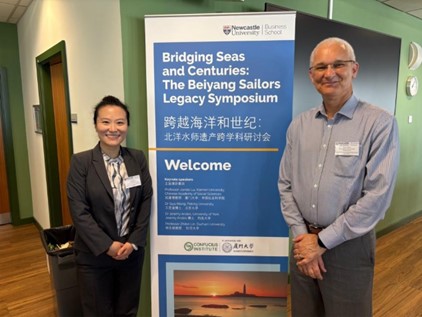 Presentation at the 'Bridging Seas and Centuries: The Beiyang Sailors Legacy Symposium', Newcastle University. July 2025
The workshop also lead to further knowledge exchange activities between LSE and ShanghaiTech University. On February 3, 2026, the chair of our workshop Xin Fan, Professor of History and Vice Dean at the Institute of Humanities at ShanghaiTech University, delivered a lecture titled 'Rethinking the concept of sovereignty in Shanghai: from the political to the cultural' to a packed room in London.
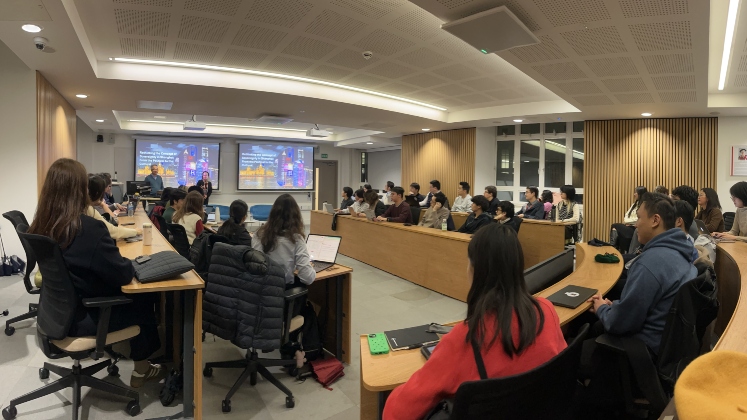 Prof. Xin Fan's lecture in February 2026 ©Qingfei Yin
How do you hope your research will contribute to a better understanding of the period?
My research aims to show that the development of China’s modern shipbuilding and shipping industries has much deeper historical roots than is commonly assumed. During the Mao era, China’s strategy for accumulating shipping capacity evolved from renting foreign vessels, to purchasing ships, and eventually to building them domestically. These shifts were responses not only to geopolitical constraints but also to fluctuations in the global merchant shipping market. Even under conditions of embargo and relative political isolation, China was part—albeit a relatively small one—of global maritime networks long before the economic reforms of the late 1970s.
More broadly, this project seeks to challenge the tendency in historical writing to focus primarily on rupture. In the case of modern China, the Communist victory in 1949 and the launch of Reform and Opening Up in 1978 are often treated as sharp breaks. By contrast, my research highlights important continuities in Chinese elite thinking about maritime strategy, particularly the long-standing pursuit of a strong mercantile fleet. Recognizing these continuities allows us to better understand both the Mao-era foundations of China’s maritime development and the longer-term trajectory that shaped China’s re-emergence as a major maritime power.
What has been your biggest takeaway?
My biggest takeaway is that, in Chinese history, what often appears to be “new” is in fact deeply rooted in much older ideas and practices. Through this research, I was repeatedly struck by the extent to which contemporary discussions about China’s maritime rise echo debates, strategies, and ambitions that were already present in the Mao era and even earlier.
This realization reinforces the value of historical scholarship in contextualizing headlines and policy anxieties. Historians are uniquely positioned to place contemporary developments within longer temporal frameworks, helping us move beyond narratives of sudden rupture and encouraging a more historically grounded understanding of the present global order.
If you are working on an international project and want to discuss how we can support you, contact our Global Research Partnerships & Alliances Dr Mengxi Pang and check our funding opportunities pages.