Intended Learning Outcomes

Left hand column for Authorcard, pullquotes etc.

Intended Learning Outcomes describe what a student will be able to do if they successfully complete a course. They are written when a new course is designed and approved, and later course convenors may propose updates. There are usually 5-7 ILOs for a course. 

They are useful to communicate the essence of the course to current and potential students, and to other staff, including as part of the handover to a new course convenor.  

Course level Intended Learning Outcomes should link ‘upwards’ to the Programme-Level Learning Outcomes, which lay out what a student should be able to do having completed the entire programme. 

Creating a foundation through constructive alignment

ILOs also form the first step for the constructive constructive alignment of the course, at the time of the course first being designed, and during any future adjustments.

  • Assessments are selected which will test whether students have achieved the learning outcomes 
  • Teaching and learning activities are chosen to develop students towards the outcomes 

How are ILOs structured?

Rather than solely describing the course content, ILOs emphasise what a student can do. These could include core knowledge, and skills and graduate attributes. They are usually phrased as bullet-points, following the stem sentence: By the end of this course, the students will be able to...  

The ‘knowledge’ of the course should thus be articulated through specific activities: for instance, will students be able to identify an argument, evaluate explanations, select appropriate evidence, apply a method? Elaborations on Bloom’s taxonomy of learning (see diagram below) may help you to find the words to describe the learning on your course.  
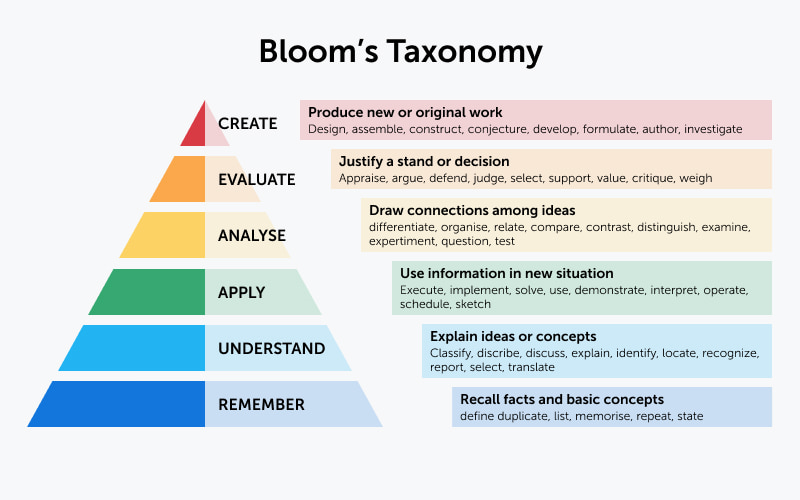
 

A diagram showing Blom's revised taxonomy. Ascending levels on a pyramid, each level with a key term, a short description and then a series of relevant verbs. The levels read: Bottom level: Remember. Recall facts and basic concepts. Define, duplicate, lis
Bloom's taxonomy of cognitive learning dimensions (1956) with elaborations
ILOs can also describe
  • Transferrable/graduate skills and attributes
  • The scope of the course: concepts, locations/eras, the materials or tools with which the student is working. 

All students who successfully complete the course should be able to complete the outcomes; no learning outcomes can be a ‘stretch goal’, for high achievers.  

ILOs are phrased as ‘intended’ because any course of study has additional positive outcomes for individuals which cannot be anticipated. 

Sharing the ILOs with students

ILOs should be communicated to students:  

  • To help course participants understand what is expected of them 
  • If the course is an option course, to inform the selection process. 

You could share them through Moodle, and refer to them during contact hours when relevant. For this reason, ILOs should be comprehensible to students, although they will probably use some specialist terminology which the student may not fully understand at the course outset. 

Examples of ILOs

M-Level course in Behavioural Science 

By the end of the course the students will be able to:  

  • Identify and discuss the methodological tools across experimental psychology and economics that are essential for designing advanced behavioural science research.   
  • Apply these tools in their own research, which should propel them to produce top-quality research for their dissertations.  
  • Analyse experimental data that probed causal mechanisms behind behavioural change.  
  • Evaluate the quality of advanced research publications in behavioural science.  
  • Create their own experiments that involve behavioural priming, implicit cognition, preferences, attitudes, strategic games, etc. and/or probe mechanisms behind causal effects in behavioural research. 

M-Level course in International Relations 

By the end of this course students will be able to: 

  • comprehend and evaluate the war and society tradition 
  • apply this tradition to the analysis of world politics and assess its significance 
  • evaluate the role of war in historical, social and political change 
  • diagnose the relationship between war and knowledge about war (reflexivity) 
  • read, interpret, and critique monograph length texts 

Further advice and support

Eden Centre departmental advisers can work with you on identifying and drafting your ILOs.


Right hand column for useful information, pullquotes, promo boxes, etc.