LSE at Party Conferences 2026
LSE takes new, policy-focused research to party conferences every year to help inspire debate and support policy thinking.
In 2026 we are focused on devolution, economic growth, political communications, and and welfare so a broad range of topics that reflect the big conversations of the year.
At Reform UK's Conference, we partnered with Total Politics on a fringe event panel to discuss the current tax code and what can be done to improve it.
At the Liberal Democrat Conference we are co-hosting the Health and Care Reception with The Health and Care Forum on the future of health and care in the UK - the factors that influence it and how government can improve it.
The Health and Care Reception 18:30 – 19:30, Monday 21 September, Meeting Room D, The Brighton Centre (secure zone)
Ed Stubbs, Dr Derek King and Josie Dixon from LSE's Care and Policy Evaluation Centre (CPEC) will be on-hand to discuss the future of health and care in the UK, and the Catalogue of Social Care Data (CASCID), the most comprehensive directory of social care data in the UK.
At the Labour Party's Conference, we have a number of events on Monday 28th September.
Jenevieve Treadwell, LSE’s London Policy Fellow, will be sharing new polling of Londoners' attitudes towards housing and devolution. This event, London's Housing Crisis and the Role of Devolution, is a roundtable in partnership with BusinessLDN.
Over on the Liverpool Docks, we're partnering with LabourList to deliver:
New Narratives for a new era: How can political parties cut through malaise? 11:15 – 12:15, Monday 28 September, Revolution, Atlantic Pavilion, Albert Docks
This panel event with Professor Tony Travers CBE and Dr Nick Anstead will focus on how Labour can craft and land successful, and optimistic, new narratives that cut through the noise and negative social media space, focusing on what messaging works, what doesn’t, and why it’s so important. You can read what Nick has to say here in a blog published by LabourList ahead of the conference and, if you are in Liverpool, we hope you can join us.
Also taking place that day, Dr Kate Summers joins Alan Milburn and others to discuss the future of welfare policy in light of Milburn's review. Find the full listing here (conference pass required).
How can Labour build an affordable welfare system that supports sick and disabled people? 12:00 - 1300, Monday 28 September, Arena Room Sherwood, Convention Centre.
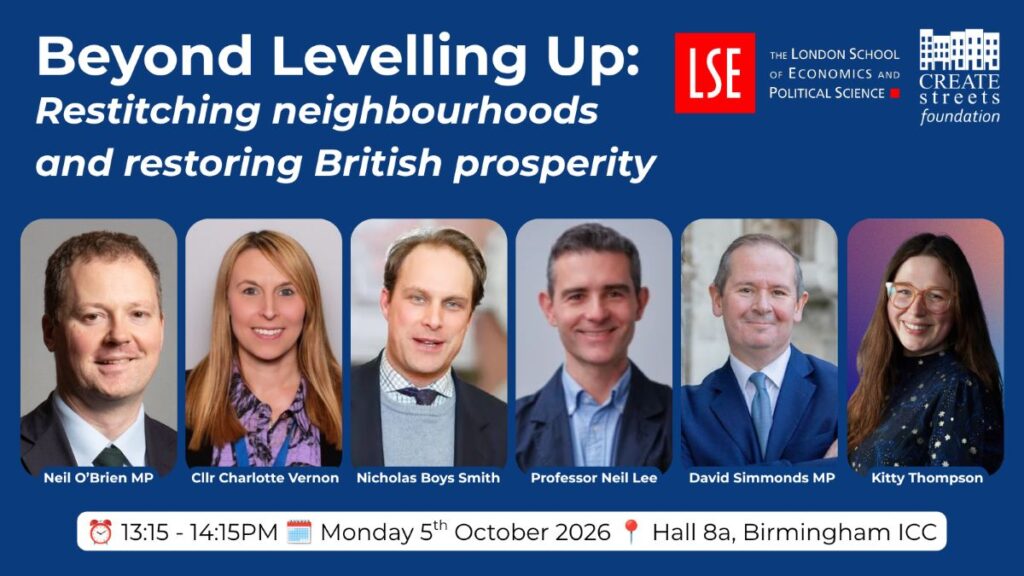
At the Conservative Party's conference, on Monday 5 October in Hall 8a, Birmingham ICC, in partnership with the Create Streets Foundation, LSE's panel discussion will consider how local government could be reorganised to pave the way to local prosperity, growth and innovation. LSE's Professor Neil Lee is a panellist alongside Neil O'Brien MP and David Simmonds MP.
Other LSE academics at conferences include: Dr Andy Summers and Prof Arun Advani, who focuses on reform to the UK's tax system, and Prof Kitty Stewart who does work across social policy
If you are interested in our other party conference events, please get in touch with the Team at comms.publicaffairs@lse.ac.uk.
England’s Towns Roundtables
High Streets in England’s Towns
In October, LSE brought together MPs representing English towns and academics with expertise in what makes for a prosperous and thriving high street to reflect on how to practically deliver on the Pride of Place Strategy. Prof Suzi Hall, Prof Tony Travers and Dr Sacha Hilhorst shared their insights on how people interact with their high streets and where the focus for thriving high streets could be.
Growth in England's Towns
In June, LSE brought together MPs representing English towns and academics with expertise in local growth, devolution and innovation policy for a roundtable in Parliament to discuss growth in England’s towns. Prof Tony Travers, Prof Riccardo Crescenzi, and Prof Neil Lee shared their insights on what the Government can – and should – do to ensure economic growth is distributed evenly across the country and that England’s towns are not sidelined in the push to grow our cities.
A summary of the discussion is available here.
A Dinner with Deputy Mayor Howard Dawber
London is the UK's economic engine and the Government's growth agenda depends on the capital's economy evolving to meet new challenges and seize new opportunities. Howard Dawber, the Deputy Mayor of London for Business and Growth, recently met our academics to discuss what enables and generates economic growth. Conversations like this are an invaluable opportunity for exchanging ideas and perspectives and the discussion was wide-ranging and valued by both sides.
Children's Wellbeing and Schools Bill 2025 Roundtables
LSE is partnering with the Education Policy Institute (EPI) to produce a series of roundtables centred around the Children’s Wellbeing and Schools Bill as it makes its way through Parliament.
The series sees LSE academics in conversation with expert representatives from the House of Lords, Civil Service, local government, children’s charities and think tanks, and the education sector.
The roundtables centre on five key themes in the Bill: child poverty; accountability; teacher supply and the leadership pipeline; special educational needs and disabilities (SEND); and a concluding roundtable focused on having happier children at school.
This first roundtable, held in January 2025, discussed the Government’s measures to reduce child poverty in both the Bill and upcoming Child Poverty Strategy.
Read a summary of the discussion and policy recommendations from attendees below.
LSE and EPI Child Poverty Roundtable January 2025.
The second roundtable will explore the implications of the Bill for the future of the accountability system, including changes to rules around automatic academisation, legal duties around admissions, and changes to the autonomy of academies. Participants considered how the new requirements on academies will impact how schools and MATs are judged, what is needed from report cards to measure schools in the round, and how to improve how schools work in their local area and collaborate with councils.
Read a summary of the discussion and policy recommendations from attendees below.
LSE and EPI Accountability Roundtable February 2025
There have been debates over the potential effects on the teacher supply and leadership pipeline as a result of proposals to change pay rule and qualified teacher status. Experts will consider the interrelationship between the Bill, recruitment and retention, and other contextual challenges affecting the teacher supply. They will also consider what more is needed from a workforce strategy to tackle the ongoing employment crisis.
LSE and EPI Teacher Supply and Leadership Pipeline Roundtable February 2025
This roundtable will be looking at inequalities in SEN provision, alongside specialist teacher training and the tension between different levels of government, alongside how these can be addressed in the short, medium and long term.
LSE and EPI SEND Provision Roundtable March 2025
The final event in this series explored how the provisions in the Bill will make children happier at school, how the legislation can be translated into real-world, measurable improvements, and what more might need to be done in the future.
LSE welcomed Sarah Smith MP, the Government’s Opportunities Mission Champion, to the roundtable and met with Vice President and Pro Vice Chancellor (Education) Prof. Emma McCoy to discuss the current work at LSE pertinent to this, such as our Widening Participation programmes.
LSE and EPI Children's Wellbeing Roundtable 25.06.25