In July 2025, LSE and Tsinghua University launched the inaugural Sustainability Research Fund with the intention of addressing global challenges and fostering collaboration between the two leading institutions. Less than a year later, the 12 funded projects are already having impact even as the research is ongoing.
From 9 – 10 April 2026, the Strengthening the Resilience of Food Supply Chains Through International Cooperation project team gathered in Beijing to deliver preliminary findings and discuss policy implementation with experts, hosted by Tsinghua’s Department of Earth System Science. The full team includes Alice Bian (PI), Professor Elizabeth Robinson (Co-I), and Professor Deborah James, at LSE, and Professor Wenjia Cai (PI), Professor Lan Xue, Yujuan Wang, PhD students Yihui Liu, Jianxiang Shen, and Hanyi Wu, at Tsinghua University.
The project scope
Their two-year pilot research project aims to explore China’s role in addressing the critical challenge of improving food security in a climate-insecure world. More specifically, the investigation objectives are to improve understanding of how climate risks affect the trade flows of major staple crops (including rice, wheat, maize, soybeans, and potatoes) in China, and to examine effective climate adaptation and resilience strategies that can ensure the stability of long-term food supply, informed by local community insights and global public policy perspectives. Uniquely positioned to develop cross-departmental collaboration, the project sits between the Grantham Research Institute and the Department of Anthropology at the LSE, and the Department of Earth Science and School of Public Policy and Management at Tsinghua University.
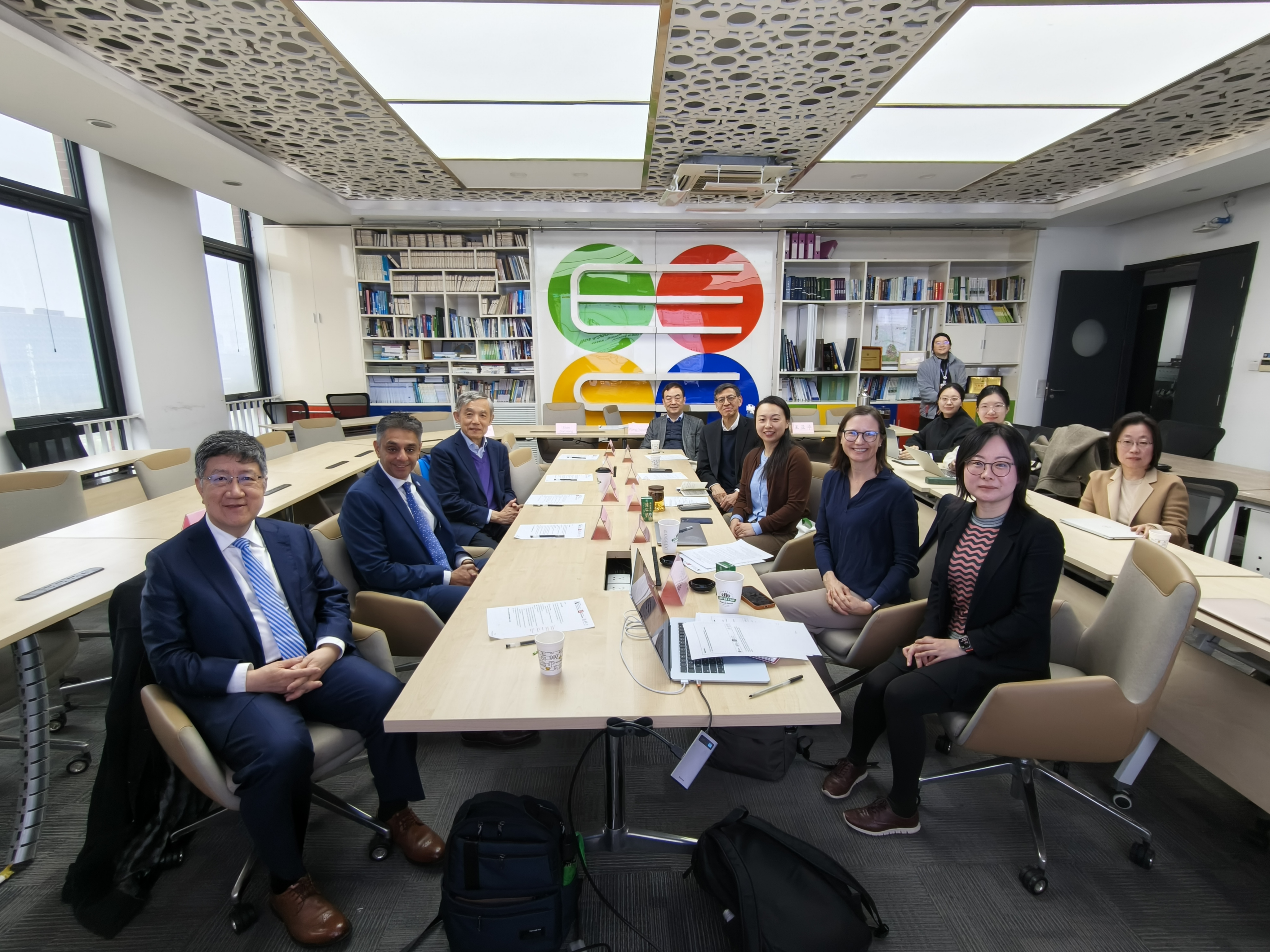 Distinguished experts attended the workshop to share their perspectives regarding China’s role in global food and nutritional security. Photos © Tsinghua University. From left to right: Professor Zheng Li (Tsinghua), Mr Carlos Aldeco-Reyes (FAO), Professor Lan Xue (Tsinghua), Professor Jintao Xu (Peking University), Professor Shenggen Fan (China Agricultural University), Professor Wenjia Cai (Tsinghua), Professor Liz Robinson (LSE), and Alice Bian (LSE).
Collaborative discussion with experts
Starting on 9 April, the joint LSE-Tsinghua project team kicked off with a high-level closed-door event, beginning with Professor Zheng Li’s welcome remarks (Dean of the Institute of Climate Change and Sustainable Development at Tsinghua University). Senior attendees included representatives from China Agricultural University, Tsinghua University, Peking University, the Chinese Academy of Agricultural Sciences, and international organisations such as the Food and Agriculture Organisation of the United Nations (FAO).
The following conversation was chaired by Professor Robinson (LSE), with the project team presenting preliminary research findings to initiate a discussion with the attending experts. The team focused on the nexus challenges of climate change, food and nutritional security, with a particular focus on trade and supply chain vulnerability, such as soybean trade, and identified priority actions needed going forward. Professor Cai (Tsinghua) and Wu (Tsinghua) shared evidence on heat, extreme rainfall and drought and their implications for food security in China, followed by analysis of food production and prices and trade flows, as well as changing food demand in Beijing and Shanghai. Bian (LSE) presented on China’s 15th Five-Year-Plan priorities to address systemic risks to food security, and its distinctive approach to food price stabilisation and the challenges of addressing the food-climate-trade nexus.
From this conversation with attending experts, the team co-developed research priorities. A policy brief will be shared with senior policymakers supporting the implementation of the 15th Five-Year-Plan (2026 – 2030), as well as with the FAO and World Bank, among others.
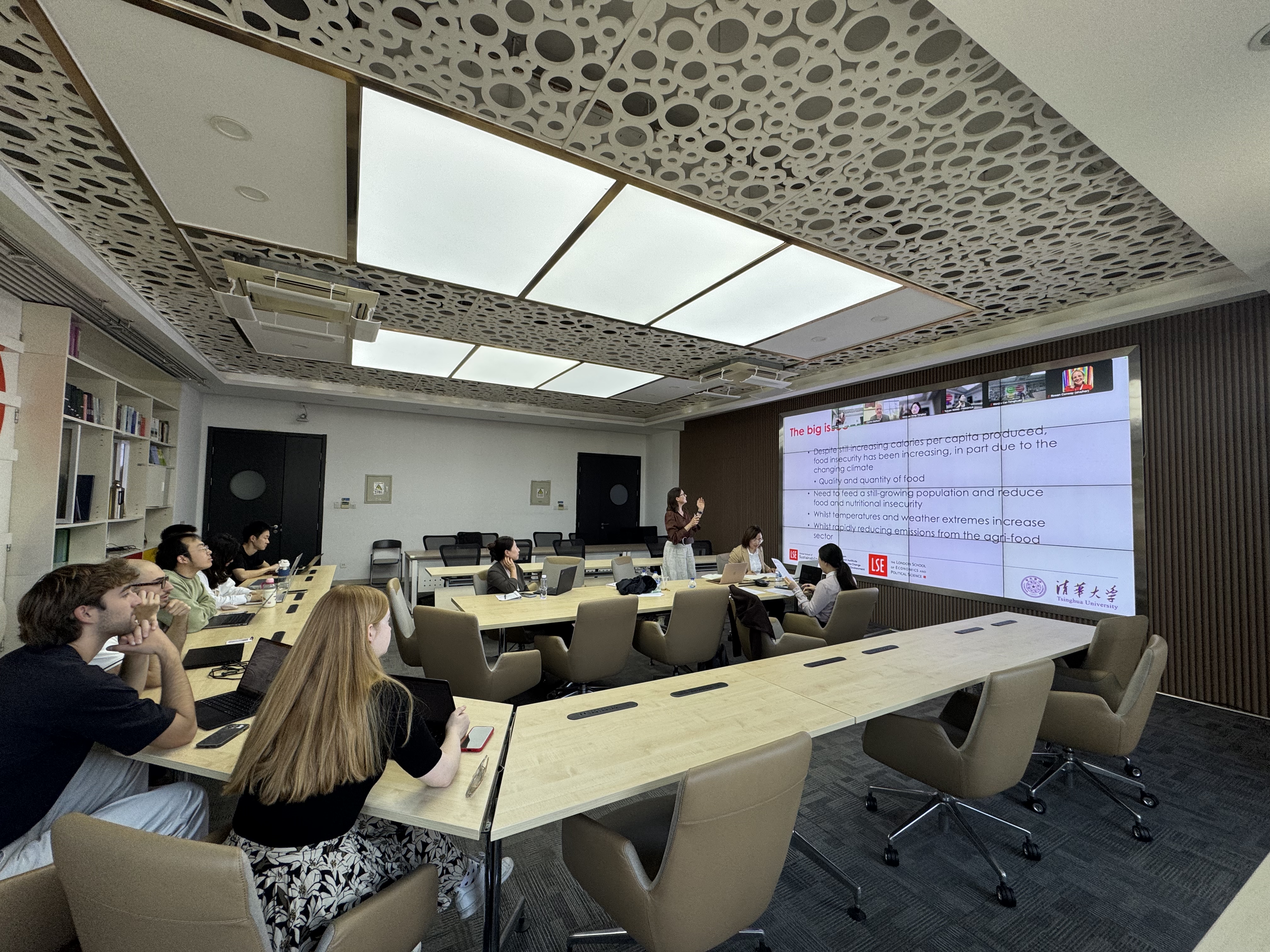 Professor Liz Robinson delivered a lecture on “Food Security in a Climate Insecure World,” including how to attribute changes in food security to the changing climate; and tackling short, medium, and long-run risks. Photos © LSE.
Collaborative research seminar and knowledge exchange
The next day, the inaugural hybrid LSE-Tsinghua University research seminar on climate change, food security, and health took place. The seminar was moderated by Dr Wenjuan Dong (Tsinghua), the managing secretariat of the fund at Tsinghua, and opened by Professor Charles Stafford (LSE).
It included by two keynote presentations by Professor Robinson (LSE) and Professor Cai (Tsinghua). Professor Robinson (LSE) discussed the extent to which climate change is affecting food insecurity, making it harder to ensure a still-growing population has access to sufficient, and sufficiently nutritious, food. She also explored key short-, medium-, and long-term priorities for policy-oriented action. Professor Cai (Tsinghua), also the Director of the Lancet Countdown on Health and Climate Change for the Asia regional centre, highlighted how their climate and health research, with a focus on health adaptation to extreme heat, has influenced decision-makers in China. Finally, Bob Ward (LSE) delivered a virtual video message to highlight the role of the newly established National Heat Commission, hosted by GRI, in addressing heat and health risks in London.
Additional engagements discussing sustainability research
During the following week, Robinson (LSE) was also invited to deliver three research seminars at the Vanke School of Public Health, the Institute of Energy, Environment and Economy, and Institute of Climate Change and Sustainable Development at Tsinghua University, thereby adding more opportunities for mutual learning and exchange. Another engagement, facilitated by Bian (LSE), brought researchers together from LSE and the China Institute for Rural Studies and the Institute for National Parks at Tsinghua.
Following on from, and building on the workshop, Professor Robinson (LSE) and Bian (LSE) also visited Xiamen University to strengthen international collaborations on climate change, food security, and health, particularly in the context of the blue economy and resilient livelihoods in mangrove-dependent communities.
Want to stay up to date with LSE’s International Strategy and Academic Partnerships team? Be the first to know about international projects by subscribing to our newsletter.