Last week, LSE’s Eden Centre co-hosted the Global Approaches to Generative AI in Higher Education conference, an international gathering focused on how artificial intelligence is transforming universities worldwide.
The event was put on with fellow Digital Intelligence International Development Education Alliance (DI-IDEA) network members, King’s College London (KCL) and Peking University (PKU), bringing more than 100 senior leaders and scholars to London for two days of keynotes, panels and collaborative discussions.
Held on 28–29 April 2026, the conference opened on LSE’s campus with a welcome from Dr Claire Gordon, Director of the Eden Centre, alongside senior representatives from KCL and PKU, Professor Samantha Smidt and Professor Sun Hua, respectively.
The programme featured a keynote dialogue on the future of universities in an AI‑transformed world, led by Vice President and Vice Chancellor for Education, Professor Emma McCoy (LSE), Vice Chancellor and President, Professor Shitij Kapur (KCL), and Provost and Vice Chair, Professor Jiang Guohua (PKU). Each speaker explored how institutions must adapt to rapid advances in generative AI, ultimately embracing AI not only in research but also teaching and education.
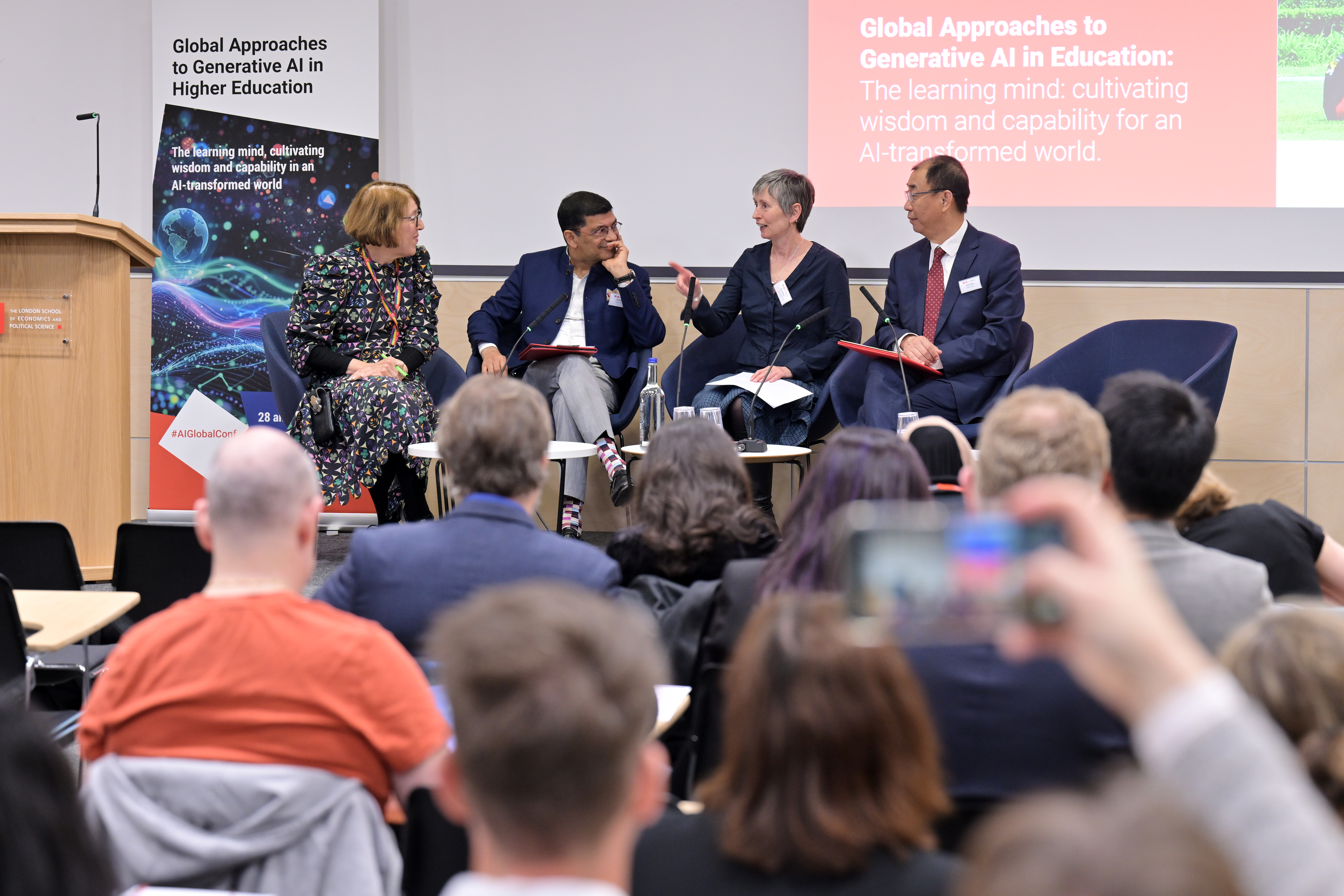 Photo of the opening panel from left to right: Claire Gordon (LSE), Shitij Kapur (KCL), Emma McCoy (LSE), and Professor Jiang Guohua (PKU).
A central offering of the event was the DI‑IDEA panel, chaired by Professor Ying Zhang of PKU's Guanghua School of Management, which featured leaders from Lingnan University, Taejae University, Dublin City University, and Nanyang Technological University. The speakers examined institutional readiness in the new digital age and the emerging need for global collaboration in AI governance and pedagogy.
The conference also highlighted LSE’s own innovations in a practice‑sharing session with LSE’s AI and Education Fellows, who presented research on AI‑enhanced learning design, assessment, and student engagement across subjects, including Psychology and Behavioural Sciences, Economics and International Development.
Keynotes throughout both days addressed the evolving relationship between human and machine intelligence, and how universities can respond to this rapid change. On day one, Giles Carden, Chief of Staff and Chief Strategy Officer at the University of Southampton, delivered an address on AI and the future of universities, followed by Professor Chris Dede, Associate Director for Research at the National AI Institute for Adult Learning and Online Education at Harvard University, who spoke on uniting human minds with digital systems to support higher‑order thinking.
On day two, attendees heard the final keynote from Valerie Focke, King’s College London alumni and representative from Open AI, on how infusing AI into curriculum can be transformative in preparing students and graduates to enter the workforce. This was complemented by an employer panel with representatives from IBM UK Early Professional Programmes, the Institute of Student Employers, Open AI, Freshfields, and Hugh James, where the speakers interrogated how AI is shaping the world of work for graduates and the ways institutions can adapt for success.
The second year of the conference, Global Approaches to Generative AI in Higher Education continues a growing international effort to share research, develop best practices and shape global policy on generative AI in higher education.
 Want to stay up to date with LSE’s International Strategy and Academic Partnerships team? Be the first to know about international projects by subscribing to our newsletter.
Photos © C. Goodwin